

Network infrastructure insights
Introduction
As of January 2026, enterprises across the United States are facing increasing demands on their network infrastructure.
Hybrid work models, cloud-based applications, and high-speed data transfer requirements have made robust, scalable
networks more critical than ever.
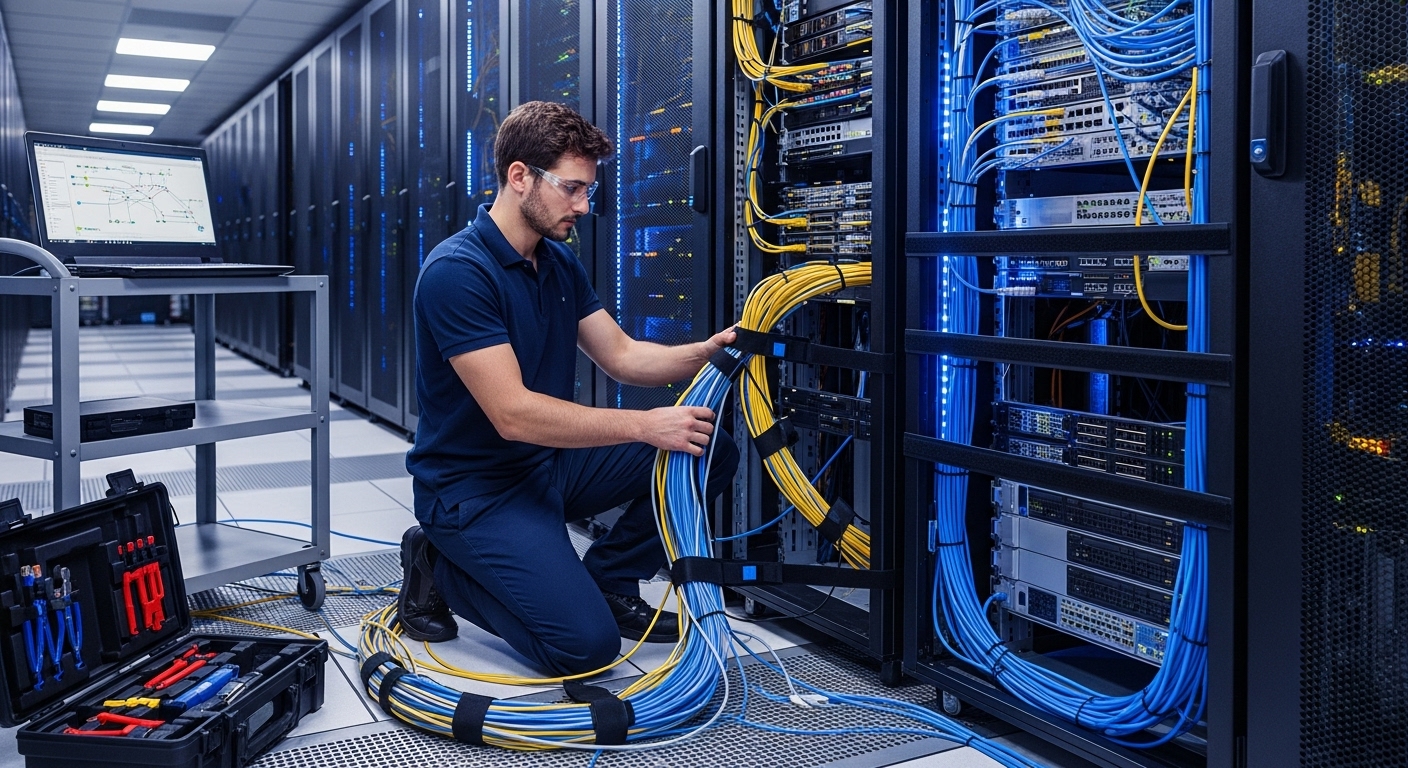
At SHIK Systems, we provide expert insights and best practices for designing, implementing, and maintaining enterprise
network solutions. This article explores the latest trends, technologies, and strategies in network infrastructure,
structured cabling, fiber optics, and enterprise connectivity.
Current Trends in Network Infrastructure
Hybrid Work and Network Demands
The shift to hybrid work models has increased the need for secure, high-speed connectivity across multiple locations.
Enterprises are investing in scalable network solutions to ensure employees have reliable access to cloud applications
and collaboration tools.
High-Speed Connectivity Needs
Fiber optics and advanced Wi-Fi standards, including Wi-Fi 6 and Wi-Fi 7, are becoming standard in corporate environments.
High-speed connectivity is essential for video conferencing, real-time data analytics, and large file transfers.
Sustainable and Energy-Efficient Networks
Modern organizations are prioritizing green IT. Energy-efficient switches, servers, and structured cabling help reduce
operational costs while supporting sustainability initiatives.
- Hybrid work-ready network architectures
- High-speed fiber optic and Wi-Fi 7 deployment
- Energy-efficient and scalable network solutions

Best Practices for Structured Cabling and Fiber Optics
Planning and Design
Effective network infrastructure begins with strategic planning. Scalability, redundancy, and future expansion must
be considered at the design stage to ensure long-term reliability.
Installation Standards
Following ANSI/TIA/EIA standards for structured cabling and fiber optics ensures compliance, performance, and
long-term network stability.
Testing and Maintenance
Routine testing and proactive maintenance help identify potential issues early, minimizing downtime and ensuring
consistent network performance.
- Design networks for growth and redundancy
- Use industry-compliant cabling standards
- Perform regular testing and monitoring


Emerging Technologies & Enterprise Connectivity
Wi-Fi 7 Deployment
Wi-Fi 7 delivers higher bandwidth, lower latency, and improved performance in high-density enterprise environments,
supporting modern collaboration and IoT ecosystems.
SD-WAN Solutions
SD-WAN enables intelligent traffic management across multiple locations, improving application performance,
enhancing security, and reducing connectivity costs.
IoT and Smart Office Integration
The rise of IoT devices requires reliable and scalable network infrastructure to support automation, monitoring,
and smart office solutions.
- Wi-Fi 7 for high-density office connectivity
- SD-WAN for secure multi-site networking
- IoT-ready enterprise infrastructure

Conclusion
As enterprise networks continue to evolve, investing in modern, scalable infrastructure is essential.
By following best practices in structured cabling, fiber optics, and emerging technologies, organizations can build
reliable, future-ready networks.
Contact Us to design and implement enterprise network solutions tailored to your business needs.